
View trimming, without topping the tree
You bought the house for the water, the valley or the mountain, and the trees have quietly closed it. Getting it back is a real service, and there is a right way and a wrong way to do it.
- Method
- Windowing, crown raising, end weight reduction
- Outcome
- The view back, the tree still a tree
Before you book this one
When you need this
- The view you bought the house for has closed in over the last few years
- A single row of conifers is doing all the blocking
- You want the water or the valley back without losing the screening entirely
- You are selling and the view is worth more than the trees are
- Somebody has already topped them and it has grown back worse
What we do
- We stand where you stand and look at what is actually in the way, which is usually less than you think
- Windows are cut through a canopy rather than the whole crown coming off
- Lower limbs raised, ends reduced back to live growth that can take over
- Where a tree genuinely has to go, we say so and it goes on the estimate as a removal
- You see the result from your own window before we pack up
What to know
- We will not top a tree to make a view. Topping gives you two or three good years, then a dense mass of weak regrowth that is worse than what you started with
- We cannot cut a tree that is not on your property without the owner's say so
- If a view needs the tree gone, we will tell you that instead of pretending pruning will do it
In the Pacific Northwest a view is a thing you hire someone for, the same way you hire someone for a roof. Everybody up here understands it and almost nobody talks about how it should be done, so the default becomes the cheapest thing a truck can do in an afternoon, which is to cut the tops off.
Here is what that costs you. A topped conifer responds by throwing a mass of shoots out of the cut, all of them attached weakly to the outside of old wood. Within a handful of years the view is closed again, the regrowth is denser than the original crown, and the parts holding it on are the parts most likely to fail in wind. You have bought back three summers and made the tree less safe.
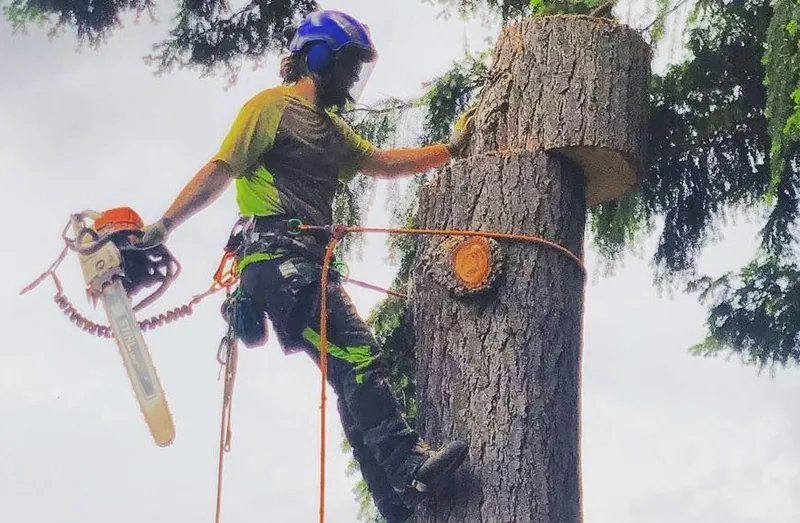
The alternative takes longer at the estimate and looks quieter when it is done. You cut selectively, you take the ends back to growth that is already there and can take the lead, you raise the bottom of the canopy, and where the sight line genuinely runs through the middle of a crown you open a window in it. You get the view, the tree keeps its shape, and nobody has to come back next spring.


Questions people ask about this
Why will you not just top them? It would be cheaper.
Because it does not last and it makes the tree more likely to fail. A topped conifer sprouts a crowd of weak shoots out of the cut face, they grow fast, they close the view again in a few years, and they are attached to the outside of old wood rather than into it. So you get a short term view, a worse tree, and a bill again sooner. We would rather do the version that holds and tell you honestly what it involves.
Can you clear a view without losing my privacy?
Usually, yes, and it is one of the more satisfying parts of this work. Screening happens at the bottom of a canopy and views usually sit above it, so raising the crown and opening a window higher up can give you the water back while the neighbors stay hidden. We look at it from where you actually sit, which is why the estimate happens at the house rather than off a map.
What if the trees blocking me are not mine?
Then we cannot touch them without the owner's permission, and neither can anybody else. What we can do is look at what is on your side, because more often than you would expect a decent part of the blocking is your own boundary planting. If a report would help you have the conversation with the neighbor, Devin can write one as a certified arborist.
Related work
Have a certified arborist look at it
Tell us what the trees are doing and we will come out, walk the property with you and write it up. The visit is free, it takes about 20 to 30 minutes, and you get an itemized estimate you can hold on to.
Call or text
(360) 842 7433Washington contractor licence WARRIBT777DF. Licensed, bonded and insured. Verify on LNI.wa.gov.ISA Certified Arborist PN 368801AEstimates are scheduled Monday to Friday, 9am to 4pm Pacific.