
Wind sail reduction pruning
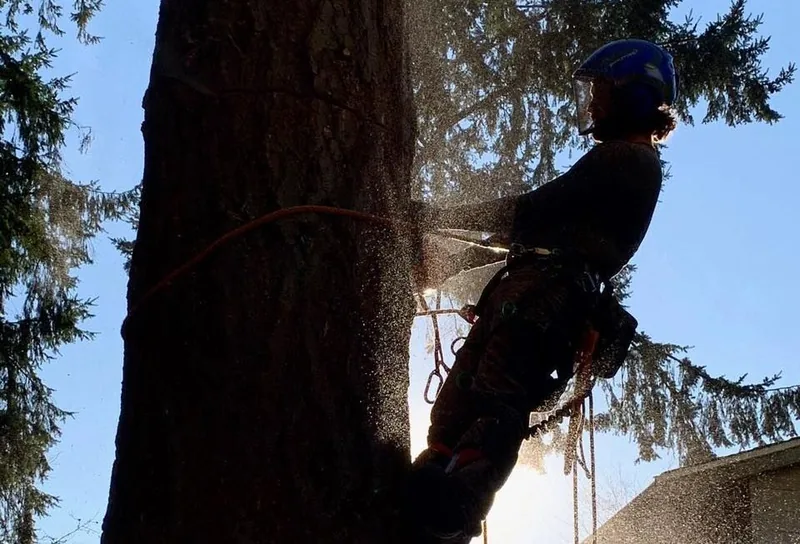
A tall conifer with a dense crown is a sail. The wind up here comes hard off the water in the winter, and the answer is not to take the tree out. It is to let the wind through it.
- Constraint
- Exposed crowns close to buildings
- Method
- Crown thinned, end weight reduced, deadwood out
- Outcome
- Less sail, same tree
Before you book this one
When you need this
- You have tall firs or cedars close to the house and you watch them move in the wind
- The crown is dense and the tree is exposed on one side
- A neighbor lost one and yours is the same age, height and aspect
- The tree stands alone where it used to stand in a group
- The ground on one side of the root plate has started to lift
What we do
- A certified arborist reads the tree, the exposure and what is under it
- The crown is thinned so wind passes through rather than pushing against it
- End weight taken off the longest limbs, which is where the leverage lives
- Deadwood out, because that is what comes down first in a blow
- An honest answer about whether pruning is enough or the tree needs more
What to know
- This is not topping and it is not the same thing. Cutting the top off a conifer creates weak regrowth and a worse problem in five years
- No pruning makes a tree immune to wind. It reduces load, and we will not tell you otherwise
- If the root plate is already failing, thinning the crown is not the fix and we will say so
Wind does not push evenly on a tree. It pushes on the surface area of the foliage, and that force is applied at the far end of long limbs, which turns it into leverage against the trunk and the root plate. A dense crown at seventy feet is a very large lever.
Reducing the sail means two things done together. Thin the crown so air moves through it instead of piling up against it, and shorten the ends of the longest limbs so the leverage arm gets shorter. Take the dead wood out at the same time, because in a real blow that is the material that comes down first and it is the material sitting directly over your roof.
What this is not is topping. Cutting the head off a conifer removes the sail for a couple of years and then replaces it with a mass of shoots growing out of a decayed cut, attached weakly, higher up, and heavier than what was there before. Devin holds a Tree Risk Assessment Qualification, which is a formal way of saying he has been trained to judge how likely a tree is to fail and what it would hit. That judgement is the entire value of this service.
Questions people ask about this
Will this stop my tree coming down?
No, and nobody honest will tell you it will. What it does is reduce how much force the wind can apply, which matters, because most failures happen when load exceeds what the wood or the roots can hold. Reducing the sail lowers the load. It cannot change a decayed trunk or a root plate that has already started to move, which is why the assessment comes before the pruning rather than after.
How much do you take off?
Less than most people expect. Thinning too hard is a mistake in its own right, because a conifer stripped inside grows a crowd of new shoots on the outside and ends up denser than it started. The target is a crown that air moves through, with the longest limbs shortened back to growth that is already there. If somebody is quoting you half the tree, ask what happens the year after.
When is the best time to do it?
Before the wet and windy months rather than during them, so late spring through early fall is the comfortable window and it is when this work is easiest to book. That said, it is ordinary scheduled pruning, not a rescue, and our estimates run Monday to Friday, 9am to 4pm with 48 hours notice. If you are looking at a tree you are worried about, get it looked at while the weather is calm.
Related work
Have a certified arborist look at it
Tell us what the trees are doing and we will come out, walk the property with you and write it up. The visit is free, it takes about 20 to 30 minutes, and you get an itemized estimate you can hold on to.
Call or text
(360) 842 7433Washington contractor licence WARRIBT777DF. Licensed, bonded and insured. Verify on LNI.wa.gov.ISA Certified Arborist PN 368801AEstimates are scheduled Monday to Friday, 9am to 4pm Pacific.